How to use a compass
- the way I use the compass to get around -
I did not intend this section to be a good (or complete) manual on how to use a compass.
It is just to give you an impression of what you can do with one. When you
buy a compass, make sure that the manual that comes with it contains a
section that explains the stuff I mention in a understandable way.
How does a compass work?
The earth has a magnetic field. A compass has a magnetic needle. This
needle reacts to the magnetic field of the earth. When this needle can
move freely, the red part will turn to the north and the white part
will turn to the south.
This method is not 100% accurate. The magnetic field of the earth can be
rotated a bit on some places. Also external magnetic fields (such as electrical
wiring inside a car) or magnetic metals (such as steel & iron of your car
or a bridge) may influence
the needle. To get a rough indication, the compass will however work well
enough.
What type of compass?
When you start looking for a compass, you will find a number of types. The
most simple ones you can find in car-shops. They are just a stick on gadget
that show the direction you are driving. These are worthless. You need
to stick them to your dashboard (and I bet they will fall off after some
sunshine). For a compass it is required that the magnetic needle (or ball
that is used in such compasses) can move freely. The liquid inside these kind
of compasses already generates a to big friction. Another thing is that you
will need to mount it on the dashboard. That happens to be the place where
most electrical wiring is... You also can not use it in the way I am going
to describe below.
When you go to an outdoor shop, they usually offer different types of
compasses. Those should come with a manual. That was also how I did find
out how they work. They start simple, just a needle without anything else. Then
they get more-and-more complex with mirrors and lenses. The mirrors can be
used to get a heading. I will get to that later, but you will not need that
unless you also plan to use it for hiking.
The type you need for driving around is almost the simpelest one. A base
plate that holds an arrow in the middle. It should have a rotatable dial
with some lines in it and a section with some wider bars. I will explain how
to use these features later in this section.

This type will do: A base plate with an arrow in the middle. The needle
should be in a dial that you can rotate. The dial should have some lines
and some bars. In case you need it for hiking you are better off with a
compass equipped with a mirror (they are more expensive)
When you are going to hike, you might like to take headings. This means that
you get the direction of a recognisable object. This can be a bridge, a church-tower,
a castle, a hilltop and so on. To take a heading, you turn the compass in
the direction of the object. Some holes help you to do this. Then you turn
the dial to align with the needle. This is where the mirror helps you. After that
you can read from the compass in which heading the object is from your
position. When you can take two headings, you can define your location (when you
have a map). While driving around in a car in a developed country, you will
get to a signpost within a few minutes. You can also check which direction
the road that you are driving follows. When you like you can then check
your map to see which road you are on. You won't need to take headings to
do this. So you won't need all those gadgets...
A quick check to see which direction you're going
Once you have mounted the compass as I will tell later, you can have
a look on it to see which direction your are driving. The red
part of the needle will point to the north. The white part will point
to the south. Knowing this you can roughly see where you are going. When
you do not have a compass and the sun is shining you can use this. At 12:00
it will roughly be in the south. In the morning it will be in the east and late
in the afternoon it will be in the west.
When you are travelling you usually know which way you are going. If you took
a wrong turn somewhere, or you left a parking and went in the wrong
direction, you will notice this immediatly.
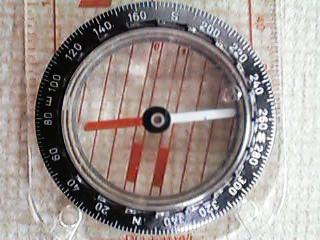
In this case you are driving towards the east. You do not need to use the
dial or the baseplate for this.
Using dial & map to verify the correct direction
This is the part that becomes a bit more complex. But once you
know how to do this, a compass won't hold that much mysteries anymore.
The first thing you need to do is set up the dial on the compass. To do this,
you take your map (with the north away from you, this will be fine on most
maps when you can read the text). Once you have this, you will place the
compass on your map. The arrow should be on top of the road that you plan to be
on. It should also point in the driving direction. Where the dial is does not
matter. Place it anywhere you like, as long as it is not in your way.
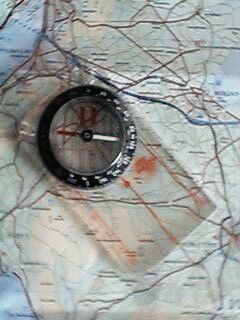
The arrow of the baseplate is on top of the road that you like to follow. It
also points in the correct direction. In this case I like to drive to the
left-bottom of the map. That is a south-east direction.
The next thing you need to do is to set the dial. Align the dial in such a way (without moving the compass) that the lines inside
the dial are parallel to the vertical (north-south) gridlines of your map. The red
bars should be pointing to the top (north).
This image shows the dial in detail. The previous image shows the dial & compass on the map as it
should be when you're finished.
Notice that you do not need to care about the needle when setting up your compass.
When you use the compass in combination with your map, you do not use
the needle. The red bars in the dial are used instead.
Once you have set-up the dial, you can place the compass in the 'holder'. You
can then verify that you are on the correct road by checking if the
red part of the needle is between the bars. A slight difference
is no problem. If the white part is between the two bars, you are
probably on the right road, but travelling in the wrong direction.
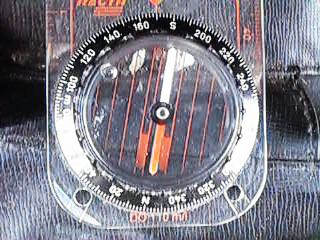
When the red part of the needle is between the 'north'-bars, you are
going into the correct direction. Usually this means that you are on the
same road as you planned to be.
Using wheel & map & signpost to find current location
Even when you do everything right, you can get to a point that you are 'lost'
(men will never say they are lost, they always perfectly know where they are...).
In that case you can drive to a junction where there is a signpost. Point your
car (or just the compass) in the direction of the road that you are on. Then
rotate the dial in such a way that the red part of the needle is between
the two bars.
Then get your map and find the place(s) mentioned on the signpost. You
can then check the junctions that you might be on by placing the
compass on your map. Don't rotate the dial and make sure that
the bars are pointing to the top (north) of the map. The road you are
on should be parallel with the arrow on the baseplate.
In fact you do the same as I wrote above. Instead of using the map to
set te dial, you now use the magnetic north.
Mounting the compass.
This can be a tricky thing and it will need some experimenting. The
compass should be placed at a location where it is not influenced
by the iron of the car. You can notice this when the needle rotates
when you move the compass. Usually a distance of about 50cm away
from the iron parts will do. The car is not a perfect cage of Faraday
so the compass will work inside.
The place should also be away from electrical wires. A car uses direct
current. This generates a magnetic field that interferes with the earth's
magnetic field. You can easily check this by swithing on/off the ignition
and other circuits using your key. Keep an eye on your compass while
switching on electrical devices (such as lights or windscreen-wipers). They
might influence the compass. In that case try other places inside the car.
Once you have found a good spot, make some kind of holder that keeps the
compass horizontal (the needle must be able to move freely, when the compass
is tilted to much this will no longer be possible). When the compass is inside
the holder, the arrow on the baseplate should point to the front of the car (parallel
with the side of the car of course). The holder should be constructed in such
a way that you can also get the compass out again. After all you will need
to set it up using your map.

Last year I did make a 'temporary' holder using some tape and a chewing
gum package. But until now I still use it... It is on plastic engine cover.
Starting the engine turns the needle around. But for the rest this is a perfect spot.
Using a compass to hold your map in the correct way
When you are holding a map, it can sometimes still be confusing to find some
places. If you happen to have a compass, you can put this on top
of your map. Then you can rotate you map in such a way that the north of the
map and the north of your compass are aligned. When you do this the
real world and the map have at least the same orientation.